
When a Church Presses Pause: What Year Two is Teaching Me About Readiness
Yesterday, a church cancelled their CareNote subscription by saying: "We're just not ready yet." It hit me harder than expected—until I realized what their honesty revealed about timing, readiness, and what it really takes for churches to successfully launch pastoral care systems.

The Moment
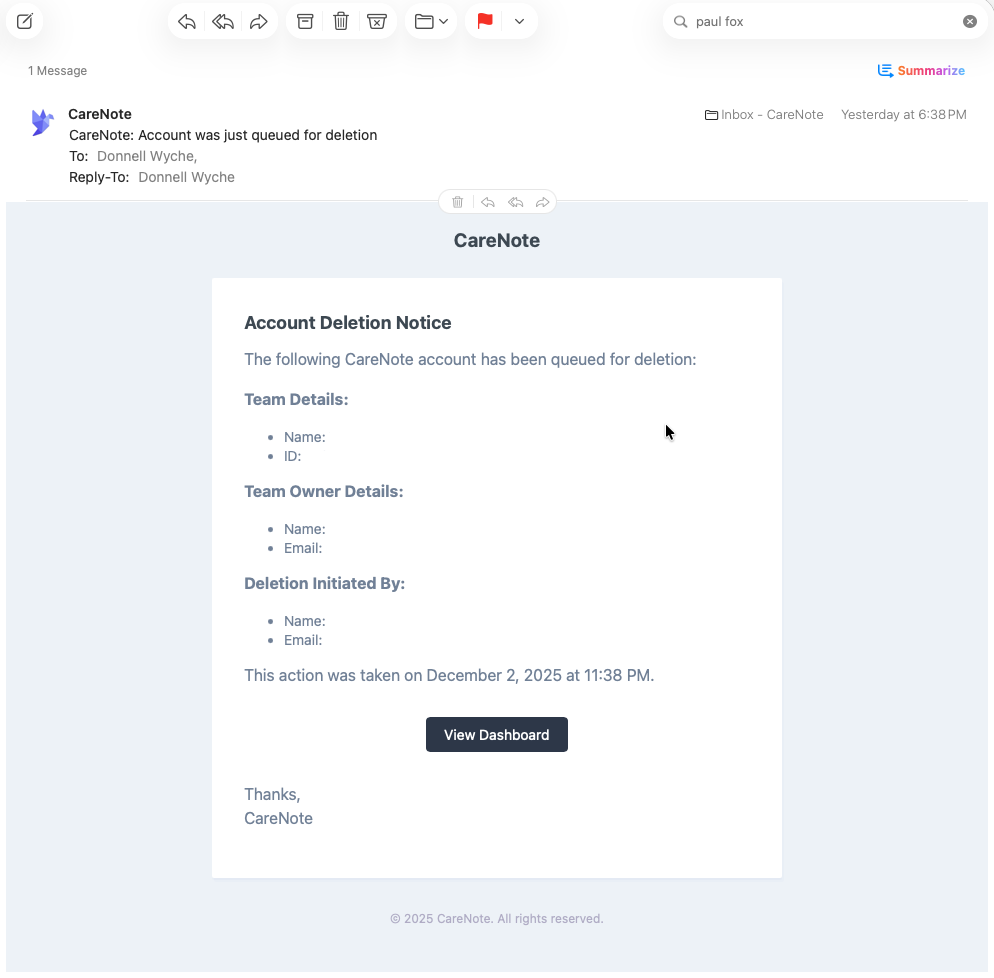
The Dreaded Account Deletion Notice
Yesterday, a church that had been steadily working to rebuild its pastoral care system reached out and asked to suspend their CareNote subscription. The message was thoughtful, gracious, and remarkably self-aware:
"Our Care ministry team is just not ready yet to take on the use of CareNote effectively. We hope within 6 months to have experience with our congregation to understand the volume of care and for our Care team and other new ministry teams to mature enough to take on using CareNote effectively. We love the app and expect to come back to it. Thank you for your support during the last few months."
Even with the affirmation—"We love the app"—it hit me harder than I expected.
CareNote has never been just a product for me. It's a ministry tool born out of lived experience—years of watching congregations struggle to follow up, track care, and protect people from slipping through the cracks. When a church joins, I feel like I'm stepping into their care system with them. When they pause or leave, it can feel personal, even though I know it isn't.
But here's what struck me about their message: they weren't blaming CareNote. They were recognizing something profound about themselves. They needed time to understand their care volume. They needed their teams to mature. They needed to build the foundation before they could effectively use the tool.
That level of organizational self-awareness is rare. And it reminded me of something that's important: churches are living, breathing organisms. They shift leadership, rethink priorities, restructure teams, and sometimes just need time to grow into their own systems. A church pressing pause isn't a failure—it's a signal. And this year has taught me to read those signals differently.
The Pattern
This week alone showed me the full spectrum of church readiness.
There was the care minister at a small but quickly growing church who reached out desperate for help. She told me she needs a unified system that provides visibility, follow-up, and clarity: Who needs help? What happened last? What's next? She immediately understood the heart of what CareNote is meant to do. Her enthusiasm was electric. And yet, even with that clarity and passion, even with a strong champion inside the church, implementation can still stall.
Sometimes the champion is ready, but the team isn't. Sometimes the team is ready, but the church structure isn't. And sometimes everyone is ready—but the timing just isn't right. The infrastructure isn't there. The volunteer culture hasn't been built yet. The leadership alignment is still forming.
Then there's Shelia, a care coordinator preparing to onboard eighty to 100 volunteers as "care partners" starting in January. We spent over half an hour on a call talking through her vision. If she had used traditional pastoral care documentation software like Notebird or Undershepherd —even with their discounts—she would have been paying over $700-800 a month. With CareNote, she'll pay around $148 a month. Her care leaders will have full accounts, while her volunteers—who only need email-based workflows—will cost a dollar each.
But what struck me wasn't just the numbers. It was the preparation. Shelia didn't just wake up one day and decide to mobilize eighty people. She's been working with her manager to define roles. She's thinking through which care requests need ongoing follow-up and which are one-time needs. She's already brought on twelve volunteers while she builds the infrastructure. She's developing training materials. She's getting budget approval. She's not rushing—she's cultivating.
When she ran into a workflow limitation (which we'll talk about in a moment), she didn't get frustrated. She problem-solved with me. She brought her manager into the conversation. She explored multiple solutions. And when I offered to build something custom for her, she said, "Let me try the existing process first and see if it works before we change anything."
That's readiness. Not just enthusiasm for the tool, but maturity in the process. The timing is right because she's making it right.
That's the pattern I'm seeing more clearly now: readiness isn't luck. It's cultivation.
The Tension
But even churches that are ready bump into real-world complexity—and that's where the partnership really matters.
During that same conversation with Shelia, she described a limitation she'd run into. She assigned a care partner to help a widow whose yard needed cleanup. The volunteer went out once to assess the situation, submitted a report, and the request closed. Then they went back to begin the work, so Shelia had to reopen the request and reassign it. The volunteer submitted another report—closed again. They needed to make a third trip to finish the job, so Shelia reopened it once more.
"Right now it's fine," she told me. "I've got twelve people on, and I've only got a handful of care requests. But when I'm envisioning what it will be with eighty volunteers... I don't know if I want to be following up on who needs to be reopened or not."
She was right to be concerned. That's an administrative nightmare waiting to happen.
So we talked through it together. I walked her through a scenario—imagine someone needs help getting their van repaired before Thanksgiving. The care partner reaches out multiple times as the situation unfolds. Should that be one continuous care request with multiple reports, or separate requests each time?
"I want a single care request for their need so I can see it from start to finish," Shelia explained. "Not spread across multiple requests."
That's when the real complexity emerged. CareNote's volunteer system was designed specifically so coordinators like Shelia could mobilize dozens of people without giving them all full user accounts. Volunteers get a secure link via email, submit their report, and they're done—no username, no password, no $10/month fee. It keeps costs manageable and removes barriers for occasional volunteers.
But there's a technical tradeoff: when a volunteer submits their report and closes the request, their access token expires. That's a security feature. Reopening the request doesn't reactivate it. So even though Shelia can reopen requests manually, her volunteers can't submit follow-up reports using their original link.
We explored several options:
- Making care partners full users (but that would cost her an additional $800/month for 80 people)
- Using tasks instead of reports (but that disconnects the activity from the care request)
- Having team leads copy and paste volunteer updates (but that's inefficient and burdensome)
- Building an email-to-report feature that extends the token expiration for ongoing care needs
"Let me try the reopening process first," Shelia said thoughtfully. "Not every care request needs multiple reports. Prayer requests are one-time. Transportation is one-time. It's really just ongoing needs like medical recovery or property work. Let me see how often this actually comes up before we build something new."
That's wisdom. And it's exactly the kind of partnership that makes CareNote better.
We want volunteers to serve without turning them into administrators. We want coordinators to manage dozens of care leaders and hundreds of volunteers without drowning in overhead. We want the system to feel effortless at scale. But we also want to keep pricing accessible, permissions sensible, and workflows intuitive and secure.
So when she asked that question, my first instinct wasn't to defend the current design. It was to say, "Tell me more about what you're trying to accomplish." Because that's what partnership requires. I committed to investigate whether we could extend token expiration for ongoing care requests, explore an email-based reporting option for volunteers, and come back to her with a clear solution and pricing model she could take to her manager. Not because CareNote is broken, but because Shelia's ministry is teaching us what churches actually need when they're ready to scale.
The Learning
Here's what this year has taught me about timing, readiness, and partnership:
Enthusiasm isn't the same as readiness. I used to think that if a care coordinator "got it"—if they understood the vision and saw the value—that was enough. But I've watched passionate champions struggle because their teams weren't aligned, their leadership wasn't on board, or their church culture hadn't been prepared for the shift. Readiness is organizational, not just individual.
Sometimes the most loving thing I can do is help a church recognize they're not ready yet. Early on, I would have seen that as losing a sale. Now I see it as protecting a relationship. If a church signs up before they've built the culture and structure to support a care system, they're setting themselves up for frustration. Better to have an honest conversation now than watch them churn out in six months feeling like they failed.
The best implementations happen when churches build culture first and systems second. The church onboarding eighty volunteers didn't start with CareNote. They started with vision, alignment, and volunteer cultivation. CareNote is the tool that lets them scale what they've already been building. That's the right order.
This is why we created the Care Ministry Implementation Hub—to help churches do the foundational work before they ever sign up for software. It walks through recruiting volunteers, building community partnerships, and developing training strategies. Because a care system without culture is just overhead. But culture supported by the right system? That's transformative.
Real partnership means absorbing complexity so churches don't have to. When that coordinator asked about multi-visit volunteer workflows, she wasn't being difficult. She was doing exactly what she should do: telling me what's getting in the way of her caring well. My job isn't to explain why the system works the way it does. My job is to figure out how to make the system work the way she needs it to—without breaking the bank or complicating the experience for everyone else.lse.
The Invitation
If you're evaluating CareNote right now, here's what I want you to know:
You might love CareNote and still realize your church isn't ready yet. That's not failure. That's clarity. And clarity is a gift. If you're a lone champion without team buy-in, if your leadership is still debating whether pastoral care should be systematized, if your volunteer culture is still forming—let's talk about that honestly. Maybe you need a few months to build infrastructure. Maybe you need help casting vision or training your team. Maybe you just need someone to tell you that waiting is okay.
CareNote isn't just software you buy—it's a partnership you enter. We're small enough to care about your specific challenges and responsive enough to do something about them. When you tell us about friction you're experiencing, we don't just log a ticket. We think deeply about how to solve it in a way that serves everyone. That coordinator's question about volunteer workflows? We're already working on solutions because her ministry matters.
The churches that thrive with CareNote are the ones who've done the foundational work. They've aligned their leadership around the vision for care. They've cultivated a volunteer culture. They've thought through who needs what level of access and why. CareNote amplifies and organizes what they're already trying to do. It doesn't create culture—it supports it.
So if you're ready—truly ready—I'd love to walk with you. Start with our 14-day free trial, but don't rush it. Take the time to think about whether your church has done the prerequisite work. And if you're not sure, reach out. Let's have a real conversation about where you are and what you need.
Because at the end of the day, we're all trying to do the same thing: make sure no one slips through the cracks. And that work deserves more than just good software. It deserves thoughtful partnership, honest assessment, and a commitment to getting the timing right.
Ready to explore whether CareNote is right for your church? Start your 14-day free trial or schedule a conversation to talk about your specific situation.